
Understanding Modern Logistics in Global Supply Chains
Logistics forms the backbone of efficient global supply chains, ensuring that goods move seamlessly from origin to destination. In today's fast-paced world, effective logistics integrates advanced technologies and streamlined processes to minimize delays and costs. This article delves into the technical intricacies of logistics, exploring how innovations in air, sea, and port operations are revolutionizing the industry. By examining key components like container tracking and automated systems, we uncover the depth of engineering that drives reliable transportation solutions.
Advancements in Air Logistics: The Role of Innovative Aircraft Design
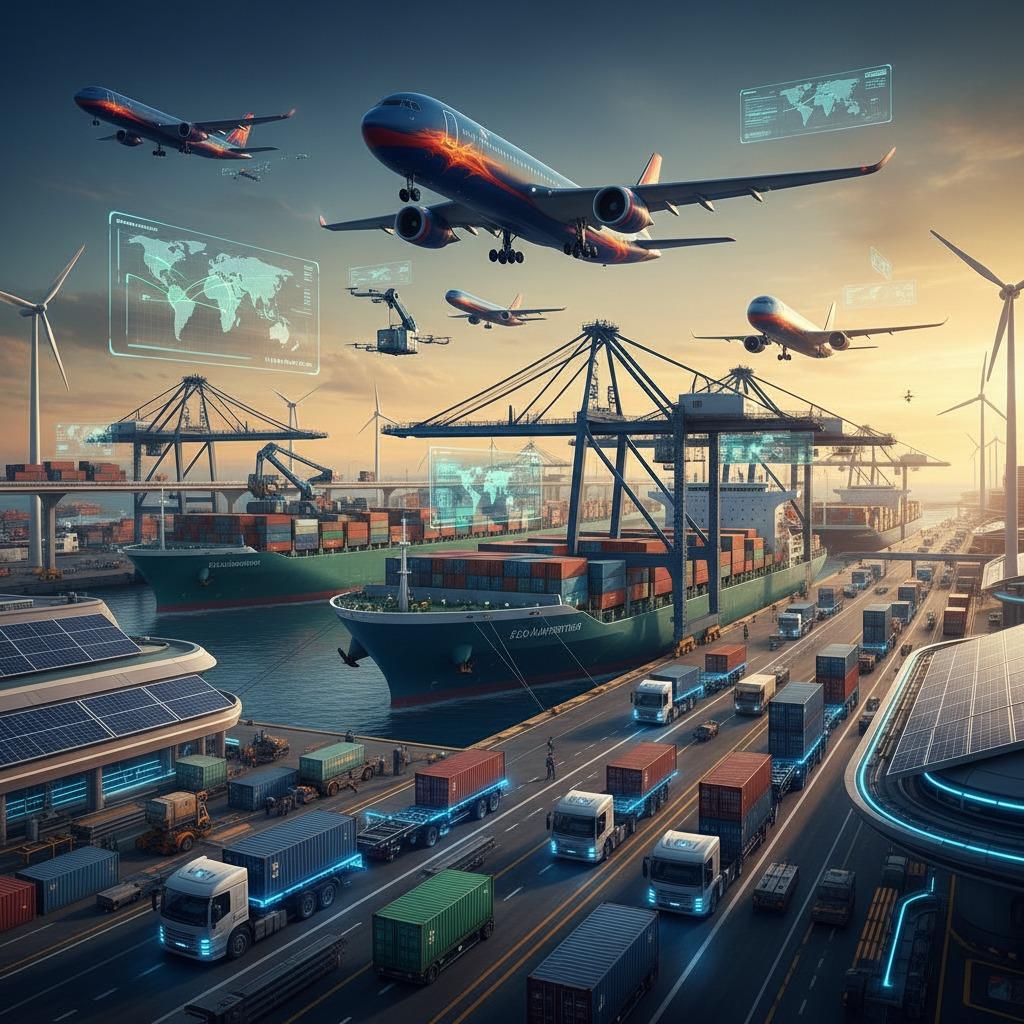
In air logistics, aircraft engineering plays a pivotal role in optimizing cargo transport. Consider a state-of-the-art aircraft with a cobalt blue and fiery red exterior, designed for enhanced visibility and aerodynamic efficiency. The streamlined fuselage reduces drag, improving fuel economy by up to 20% through precise computational fluid dynamics simulations. Powerful jet engines, equipped with noise-reduction technologies, ensure quiet operations while maintaining high thrust-to-weight ratios. These engines incorporate advanced materials like carbon composites to withstand extreme temperatures, contributing to safer and more sustainable flights. Navigation systems leverage GPS and inertial measurement units for real-time positioning accuracy within meters, crucial for time-sensitive logistics routes. This aircraft exemplifies how logistics in aviation balances speed, safety, and environmental impact, supporting global trade with cutting-edge aerodynamics.
Port Management and Maritime Logistics: Integrating Smart Technologies
Maritime logistics thrives on robust port management systems that handle massive container volumes efficiently. A modern logistics hub features IoT-enabled smart container tracking, where RFID tags and sensors monitor cargo in real-time, providing data on location, temperature, and humidity to prevent spoilage in perishable goods. AI-driven analytics process this data to predict bottlenecks, optimizing crane schedules and reducing idle times by 30%. Automated cranes, controlled via intuitive interfaces with machine learning algorithms, execute precise lifts using computer vision to align with vessel decks. For sustainability, these systems integrate solar-powered grids and emission-tracking modules, cutting carbon footprints through optimized routing algorithms that minimize fuel use in ship-to-shore transfers. Scalable capacity planning employs simulation software to forecast volume surges, ensuring ports adapt without compromising throughput. These technical features transform busy ports into efficient nodes in the logistics network.
Multifunctional Vessels: Engineering for Versatile Logistics Operations
Vessels designed for maritime logistics must endure harsh conditions while facilitating seamless integration with port infrastructure. A versatile multifunctional ship boasts a reinforced hull constructed from high-tensile steel alloys, offering corrosion resistance and structural integrity against wave impacts. Its eco-friendly engines utilize selective catalytic reduction systems to lower NOx emissions by 90%, aligning with international maritime regulations. State-of-the-art navigation includes ECDIS (Electronic Chart Display and Information System) fused with AIS (Automatic Identification System) for collision avoidance, enabling precise maneuvering in congested waterways. The spacious deck supports modular cargo configurations, with hydraulic systems for rapid loading via dockside cranes, reducing turnaround times. Interior ergonomics feature vibration-dampening materials and climate control, enhancing crew efficiency during extended logistics missions. This vessel's design underscores the technical synergy between shipbuilding and logistics, promoting reliability in supply chain execution.
The Future of Logistics: Sustainability and Integration
Looking ahead, logistics will increasingly rely on interconnected ecosystems where air, sea, and port operations converge through blockchain for secure data sharing and predictive analytics for demand forecasting. Technical standards like ISO 28000 ensure compliance in risk management, while 5G-enabled communications facilitate instantaneous coordination. By prioritizing fuel-efficient designs and automated processes, the logistics sector reduces its environmental footprint, fostering a resilient global economy. These evolutions not only enhance operational precision but also drive cost savings, making logistics a cornerstone of modern commerce.





