
Revolutionizing Logistics: The Backbone of Modern Supply Chains
In the fast-paced world of global trade, logistics stands as the cornerstone of efficient supply chain management. At its core, logistics encompasses the planning, execution, and control of the movement and storage of goods, services, and information from origin to consumption. This intricate process ensures that products reach their destinations seamlessly, minimizing delays and maximizing value. Whether through warehousing, transportation, or inventory management, effective logistics is vital for businesses aiming to thrive in competitive markets. By integrating advanced technologies and optimized processes, companies can transform potential bottlenecks into streams of productivity, highlighting why logistics is not just a function but a strategic advantage.
Advanced Warehousing Solutions in Logistics
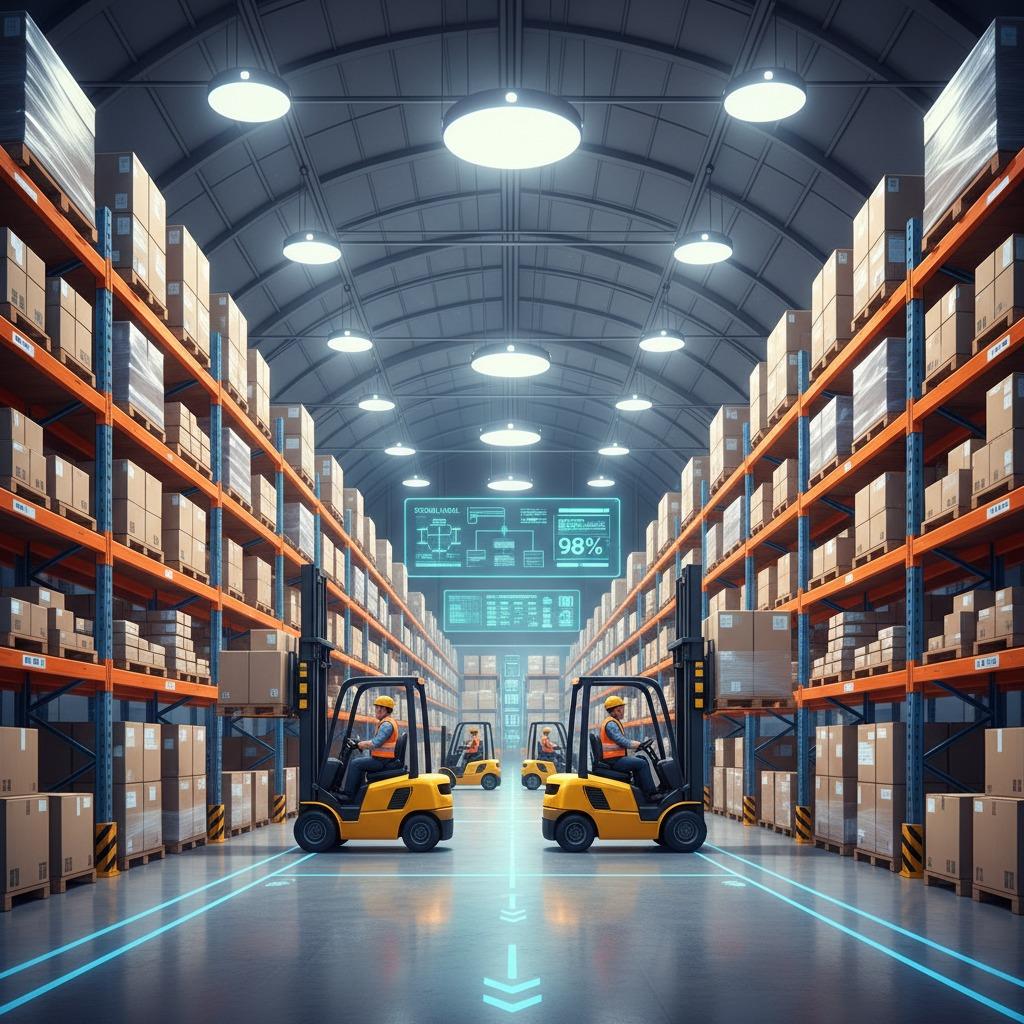
Modern logistics demands warehousing environments that are both spacious and highly efficient, designed for high-volume inventory management. State-of-the-art warehouses feature industrial-grade steel racks in vibrant orange and blue, providing durability to handle heavy daily operations while enhancing visibility through strategic overhead lighting. These setups include precision-designed aisles wide enough for high-performance yellow forklifts to maneuver effortlessly, ensuring swift and controlled handling of goods. Neatly organized rows of labeled cardboard boxes exemplify streamlined categorization and inventory tracking, reducing errors in selection, shipment, or restocking. Safety is paramount, with reinforced structures that support seamless logistics operations, making these facilities ideal for organizations focused on elevating storage and distribution capabilities. The combination of aesthetics, productivity, and safety in such warehouses underscores the technical evolution of logistics, allowing for real-time monitoring and automated systems to further optimize throughput.
Cutting-Edge Container Handling for Enhanced Logistics Efficiency
A critical aspect of logistics involves the precise handling of shipping containers, where versatile machinery like reach stackers plays a pivotal role. These advanced devices are engineered for high-performance environments such as ports and industrial warehouses, demonstrating robust handling precision for containers of various weights and sizes. Equipped with high-capacity lifting capabilities, reach stackers enable safe vertical and horizontal stacking, optimizing space in crowded areas. Their reinforced structures and advanced hydraulics ensure durability under demanding conditions, while ergonomic cabins with state-of-the-art controls prioritize operator safety and convenience. Many models incorporate eco-friendly technologies to reduce carbon emissions without compromising power, aligning logistics with sustainability goals. In global trade flows, this machinery, paired with standardized systems like Maersk containers, facilitates efficient cargo movement, emphasizing security, adaptability, and reliability. Technical specifications often include hydraulic systems capable of lifting up to 45 tons, with precision controls that minimize sway during transfers, revolutionizing how logistics hubs manage high-throughput operations.
High-Performance Rail Systems: Transforming Logistics Transportation
Rail transport represents another indispensable pillar of logistics, particularly for bulk cargo over long distances. The latest high-performance cargo and utility trains redefine efficiency with their aerodynamic designs in striking orange and gray, minimizing drag for optimal speed. Powered by state-of-the-art engines, these locomotives deliver peak traction on challenging terrains, including snowy mountains, through advanced powertrains that balance performance with energy efficiency. Modular units allow for versatile cargo optimization, maximizing capacity in spacious compartments without sacrificing maneuverability. Engineering excellence is evident in reinforced couplings, sturdy rail attachments, and cutting-edge braking systems, ensuring smooth rides and enhanced safety features like front-facing lights for visibility in adverse weather. These trains are ideal for industries like mining and manufacturing in remote regions, where hybrid power sources and operational controls minimize emissions while handling heavy loads. From a technical standpoint, their extended lengths—often exceeding 1,000 meters—combined with redundant circuits, provide reliability that propels logistics into a sustainable future, integrating seamlessly with multimodal transport networks.
Integrating Technologies for Future-Proof Logistics
To fully harness the potential of logistics, integration of technologies such as IoT sensors, AI-driven predictive analytics, and automation is essential. In warehousing, RFID tags on boxes enable real-time tracking, feeding data into centralized systems for inventory accuracy. For container handling, GPS-enabled reach stackers optimize routes within ports, reducing idle times and fuel consumption. Rail systems benefit from digital twins—virtual replicas that simulate operations for proactive maintenance, preventing disruptions. These advancements not only streamline logistics but also enhance scalability, allowing businesses to adapt to fluctuating demands. By focusing on data interoperability and cybersecurity, logistics networks become resilient against global challenges like supply disruptions. Ultimately, this technical synergy ensures that logistics evolves from a reactive process to a proactive, intelligent ecosystem, driving economic growth and operational excellence across industries.
In summary, logistics is the invisible force powering modern commerce, with innovations in warehousing, container management, and rail transport setting new benchmarks for efficiency and reliability. As businesses continue to prioritize these elements, the future of logistics promises even greater integration of smart technologies, fostering a more connected and sustainable global supply chain.





