
Revolutionizing Efficiency with Cutting-Edge Logistics
In today's fast-paced global economy, logistics stands as the backbone of successful supply chains, enabling businesses to deliver goods swiftly and sustainably. As an expert in innovative solutions, I firmly believe that embracing advanced logistics technologies is essential for companies aiming to stay competitive. This article explores how modern logistics integrates automation, smart transportation, and intelligent networks to transform operations, persuading you to adopt these game-changing approaches for unparalleled efficiency.
The Power of Automated Warehouses in Logistics
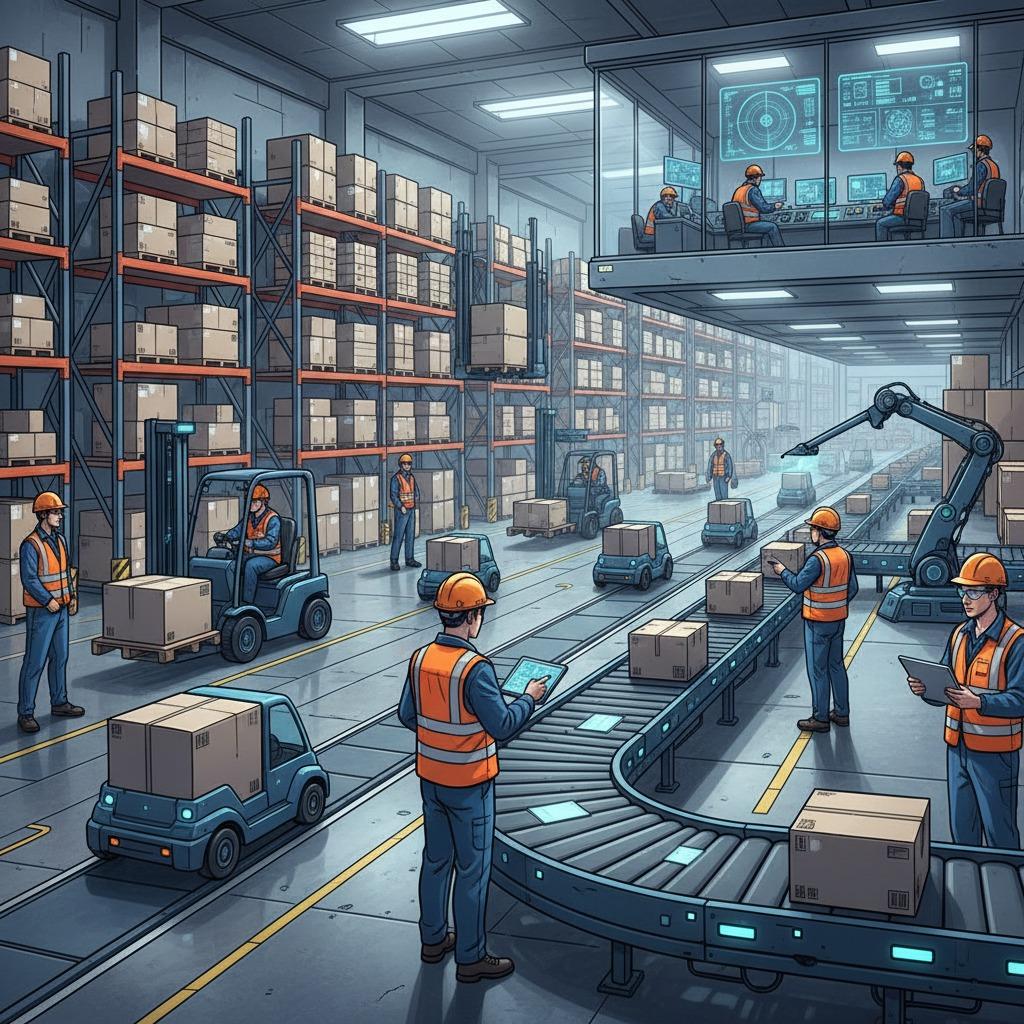
Imagine a warehouse where electric delivery vehicles glide seamlessly alongside robotic forklifts, all orchestrated by real-time tracking software—this is the future of logistics. These zero-emission vehicles, with their aerodynamic designs and illuminated accents, optimize parcel delivery while minimizing environmental impact. Workers in high-visibility gear collaborate with automated conveyor belts that handle labeling, categorization, and dispatching with precision, reducing errors and boosting productivity. Industrial-grade robotic forklifts navigate multilevel storage platforms effortlessly, ensuring safety and speed in heavy package handling. By integrating such logistics systems, businesses can achieve a dynamic workflow that slashes downtime and accelerates throughput. Adopting this logistics model isn't just smart; it's a strategic necessity to outpace competitors and meet rising demands for reliability.
Aerial Innovations Enhancing Global Logistics
Logistics extends beyond ground operations into the skies, where heavy transport and early warning aircraft redefine capabilities for military and commercial sectors. These robust aircraft, equipped with wide fuselages for immense cargo capacity and high-powered jet engines for long-distance hauls, facilitate heavy-lift logistics for equipment, aid, or urgent shipments. The integrated radar dome provides real-time surveillance, tracking air and ground activities over vast distances, which is invaluable for secure and efficient logistics planning. Advanced avionics and navigation systems ensure seamless integration with air traffic controls, even in challenging terrains. This aerial prowess in logistics not only supports global deployments but also enhances situational awareness, making it indispensable for industries requiring rapid, versatile transport. Convincing evidence from operational excellence shows that investing in such logistics assets guarantees a competitive edge in international supply chains.
Global Logistics Intelligence: Mapping the Future
At the core of transformative logistics is the Global Logistics Intelligence Network, a sophisticated map-based system that visualizes real-time connections across continents. Key hubs for manufacturing, distribution, and transit are pinpointed, supporting multi-modal transport via air, sea, land, and energy routes. This logistics platform enables rapid high-priority deliveries by air, cost-effective bulk shipments by sea, and regional connectivity via trucks and rails, all while optimizing energy use for sustainability. Real-time tracking ensures transparency and efficiency, fostering intercontinental synergy for sectors like automotive, retail, pharmaceuticals, and heavy equipment. By minimizing consumption through eco-friendly route planning, this network addresses global goals without sacrificing speed. Businesses that harness this logistics intelligence will not only streamline operations but also position themselves as leaders in a sustainable, interconnected world—urging you to integrate it today for measurable gains in reliability and scalability.
In conclusion, the evolution of logistics through automation, aerial advancements, and intelligent networks is reshaping industries worldwide. These innovations promise not just efficiency but a sustainable path to excellence, compelling forward-thinking companies to act now and redefine their supply chains.





